There’s a moment in every Cirque du Soleil show when the entire audience goes still.
An athlete launches into the air, bodies move in perfect sync, and for a few seconds, everything looks effortless. What the audience doesn’t see is the work before that moment: the preparation, the setbacks, and the team making sure each performer can step back on stage again and again.
For Certified Athletic Therapist Saro Keresteciyan, this unseen work has shaped more than two decades of his life and career.
His path into athletic therapy began long before he ‘ran away to join the circus’, he shared, with a desire to help others. As a lifeguard, he was drawn to first aid and supporting others. Then, in high school, he suffered a serious leg injury while playing football. The experience was a wake-up call, showing him how much Certified Athletic Therapists on the sidelines could support athletes. “I saw the lifestyle, working with the team, travelling...and I thought, this is kind of cool,” Saro said.
While studying at John Abbott College, Saro attended a job fair where he was introduced to Concordia University’s athletic therapy program. Seeing the possibilities of a career in the industry, he went on to earn a BSc in Exercise Science with a specialization in Athletic Therapy.
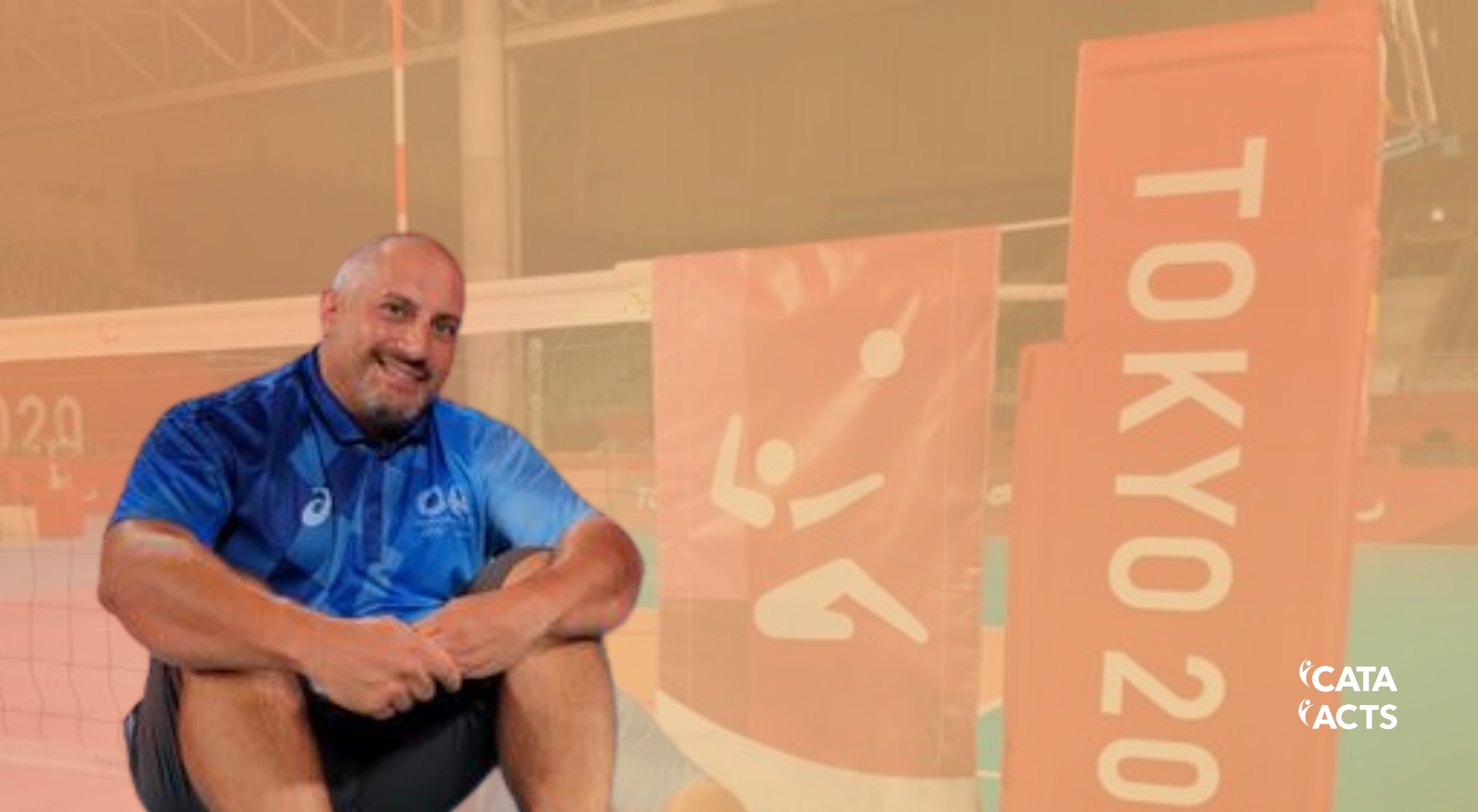
Like many in the athletic therapy profession, his early career was shaped by showing up and saying yes. While completing his studies, he worked weekend football games, gaining practical experience across different levels of play. Then, the Canadian Paralympic volleyball team arrived in Montréal for training. Newly Certified, he went to introduce himself. “I said, if you need anything, let me know, I’m here to help you out.” The team took him up on the offer, and before the end of the camp, they asked if he wanted to travel with them to Ottawa.
That one ‘yes’ led to international travel, including competitions in Poland and ultimately the 2000 Summer Paralympic Games in Sydney, where the team would earn a silver medal. “It was the check moment,” he said, speaking of his path into athletic therapy. “I knew that this was the right thing for me.”
After several years in amateur sport, Saro began looking for something that offered both stability and variety. An opportunity with an equestrian circus introduced him to a new kind of performance environment, one that combined athleticism with artistry and life on the road. When that chapter came to a close, a simple suggestion pointed him toward his next step: why not try Cirque du Soleil?
In 2005, he joined Cirque du Soleil as a therapist on the touring production Varekai. It quickly became clear that the role extended far beyond clinical work. It was the combination of travel, cultural exchange, and collaboration with performers from around the world that made it feel like the right fit.
Over the years, Saro has been a part of 11 different Cirque du Soleil productions, progressing from Athletic Therapist to Head Athletic Therapist while working across both touring and resident shows. In his current role at Cirque du Soleil’s International Headquarters (IHQ) in Montréal, his focus has shifted to long-term rehabilitation, performer development, talent assessment, and supporting the creation of new productions.
Each environment carries its own rhythm. On tour, the pace is unpredictable. “There’s never a typical day,” Saro said. “You’re treating, preparing for shows, responding to emergencies, and adapting constantly.” In resident settings and at headquarters, the work allows for greater continuity, with more opportunity to support long-term recovery and structured return-to-performance planning.
What remains consistent is the connection. Life on tour creates a unique kind of closeness, one that extends beyond colleagues. It becomes a second family, something Saro has experienced firsthand, even sharing parts of that journey with his wife and daughter along the way.
Cirque du Soleil athletes are often described as elite, but even that term falls short. “There’s no norm,” Saro said. “A back is a back, a leg is a leg, but what [these athletes] can do with their bodies…there’s no textbook for that.” Even now, he continues to be surprised by what the human body is capable of on and off stage.
At the core of his approach is a simple framework: prepare, perform, recover, developed over years of experience with Cirque du Soleil and shaped through collaboration with other professionals. These three pillars have become core values within the performance medicine team.
Recovery is something he emphasizes, especially in preparing performers for a sustainable career. Many performers come from backgrounds where the mindset is to push through pain, where the show must go on. Part of his role is teaching athletes the fundamentals of recovery and prevention, and how to properly take care of their bodies for a life after the performance.
This includes building routines, from warm-ups to recovery practices, and helping performers become more independent in how they manage their health, especially while on tour. “It’s not just about now,” he said. “It’s about how they feel after their career is done too.”
Every performer who steps out onto the stage has this entire support team behind them. Saro and the Performance Medicine team are part of every step of the process, from the initial evaluations when a performer first comes to Cirque du Soleil to their everyday needs and emergencies that come up during a performance.
When a performer is injured, determining the next step is always a team effort, from coaches and healthcare professionals to artistic directors and stage management. “It’s always a conversation,” Saro said, balancing performance demands with health and safety. “You’re looking at the performer, but you’re also looking at the safety of everybody else on stage.”
This knowledge is part of what Saro shared as his contribution to the magic of Cirque du Soleil. “When an artist is injured and not sure if they’ll be able to get back on stage, and then they do,” Saro said. “You see them, you see their smile, you see them getting the accolades and the applause. They deserve it, and you helped them get there.”
After nearly 30 years, athletic therapy is a lifestyle. “It’s my day-to-day,” Saro said. Although he still feels the urge to travel, he values his work at IHQ in Montreal and the opportunity to teach people how to move well and keep doing what they love for the long term, not just the short term. That includes his own father, whom he has supported as a Certified AT.
For those who wish to pursue a similar career path, his advice is simple: “Get out there. Work with different types of athletes. See as many injuries as you can. Don’t limit yourself.” Because in this field, no two careers and no two bodies are the same.
For Certified Athletic Therapists, stories like Saro’s are a reminder of what’s possible when skill meets opportunity. Whether your path leads to sport, performance, or something entirely unexpected, the foundation is the same.
If you’re looking to expand your scope, connect with peers, or explore where your career in athletic therapy can take you next, CATA offers resources, education, and a community built to support you at every stage. Join our community and stay up to date by following us on Instagram, Facebook and LinkedIn.