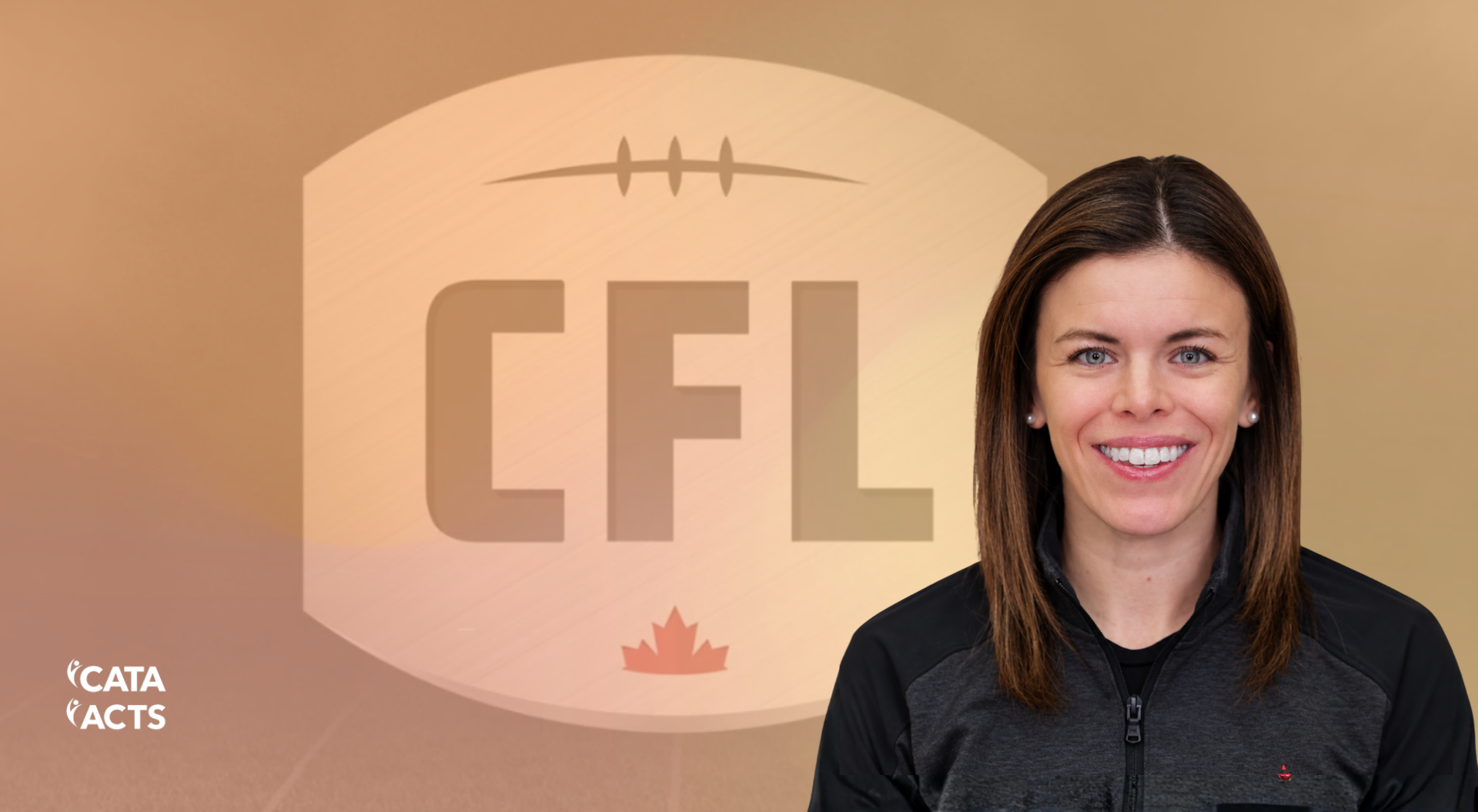
A player safety policy has to work on the sidelines, where medical staff are making decisions under pressure. Katie Mitchell begins here when considering how policies are put into practice across the Canadian Football League. As the league’s first Specialist in Player Health and Safety, she works with team medical staff and league medical leaders to understand what is working, address problems, and support consistent practices across teams.
One of her first priorities after joining the league in June was meeting each team’s head Certified Athletic Therapist to understand their experiences and what they needed from her.
“Everybody has a different story and experience and how they got into that role,” Katie said. “That really helped me from the start to understand their needs and how I could support them best.”
With this year’s Grey Cup now complete, Katie’s first season offers a look at a side of professional football that fans rarely see. Her work sits within football operations, connecting medical information, research, and the day-to-day needs of those caring for players.
A typical week might involve reviewing injury spotter reports with the league’s chief medical officers, reviewing league-wide medical policies and initiatives, or helping a head Certified AT resolve a problem with an electronic medical record. She also works directly with software providers to address issues affecting how information is entered and shared.
With evolving technologies and practices in high-performance sport, it's critical to ensure workflows transition seamlessly into the clinic and onto the sideline to support athlete health. Each case requires someone to investigate, ask questions, and follow through. Katie’s career has spanned clinical practice, education, research, and high-performance sport, with each experience adding skills she now uses at the league level.
During her academic training, she developed expertise in data analysis and injury surveillance. Research also meant managing projects, mentoring others, and responding to feedback. A former advisor’s work with the NHL Players’ Association introduced her to roles where clinical experience and research could come together within professional sport.
Her years with Canada’s national women’s para ice hockey program brought a different kind of preparation. She explained that in Para sport, clinicians may encounter inaccessible environments, limited resources, and fewer assessment tools designed specifically for their athletes. "To prioritize athlete needs, decisions often require being adaptable to find solutions with what is available,” she said.
Even a familiar injury demands a broader view. An athlete rehabilitating a shoulder may also rely on it to use a mobility device or transfer throughout the day. Those needs have to be considered alongside a return to sport.
That experience strengthened Katie’s confidence and problem-solving. It also reinforced the habit of understanding someone’s circumstances before deciding what will work for them. At the CFL, she is careful to apply that same attention to the perspectives of team medical staff. A recommendation supported by research still needs to be feasible within their environment.
“If we’re making a decision for a league-wide policy, how does it actually get implemented?” she asked. “It’s definitely a reciprocal relationship and making sure that everyone’s voices are heard.”
Katie also helps examine what can be learned from a full season. Working with medical leaders, she supports the review of injury information, including when injuries occur and which phases of play are involved. She also conducts video analysis in various aspects of the game, including reviewing tackling characteristics and concussion injuries.
The Grey Cup brings an opportunity to discuss that wider picture. In the days leading up to the championship, medical leaders gather to review seasonal trends, player health and safety initiatives, and consider priorities for the off-season. There are operational responsibilities around the game itself, too, although Katie does not provide direct patient care in this position.
The role was created with room for its first occupant to shape it. For Katie, this has been an opportunity to use skills developed across different parts of her career, and she hopes other Certified ATs will have similar opportunities.
“I’d love to see the ability for people to move up in those organizations and have some of those leadership roles to influence player health and safety,” she said.
She also sees the need for mentorship in these positions, alongside the clinical and sideline placements more commonly associated with the profession. Her own experience offers a useful example of how those foundations can develop into work involving research, administration, and league-wide decisions.
For Katie, the next steps will continue to be shaped by the people doing the work: listening to their concerns, understanding the problems they encounter, and helping find solutions they can use.
Explore where your career in Athletic Therapy could take you. Connect with CATA for resources, education, and a professional community, and follow CATA on Instagram, Facebook, and LinkedIn to learn more about Athletic Therapy.
One of her first priorities after joining the league in June was meeting each team’s head Certified Athletic Therapist to understand their experiences and what they needed from her.
“Everybody has a different story and experience and how they got into that role,” Katie said. “That really helped me from the start to understand their needs and how I could support them best.”
With this year’s Grey Cup now complete, Katie’s first season offers a look at a side of professional football that fans rarely see. Her work sits within football operations, connecting medical information, research, and the day-to-day needs of those caring for players.
A typical week might involve reviewing injury spotter reports with the league’s chief medical officers, reviewing league-wide medical policies and initiatives, or helping a head Certified AT resolve a problem with an electronic medical record. She also works directly with software providers to address issues affecting how information is entered and shared.
With evolving technologies and practices in high-performance sport, it's critical to ensure workflows transition seamlessly into the clinic and onto the sideline to support athlete health. Each case requires someone to investigate, ask questions, and follow through. Katie’s career has spanned clinical practice, education, research, and high-performance sport, with each experience adding skills she now uses at the league level.
During her academic training, she developed expertise in data analysis and injury surveillance. Research also meant managing projects, mentoring others, and responding to feedback. A former advisor’s work with the NHL Players’ Association introduced her to roles where clinical experience and research could come together within professional sport.
Her years with Canada’s national women’s para ice hockey program brought a different kind of preparation. She explained that in Para sport, clinicians may encounter inaccessible environments, limited resources, and fewer assessment tools designed specifically for their athletes. "To prioritize athlete needs, decisions often require being adaptable to find solutions with what is available,” she said.
Even a familiar injury demands a broader view. An athlete rehabilitating a shoulder may also rely on it to use a mobility device or transfer throughout the day. Those needs have to be considered alongside a return to sport.
That experience strengthened Katie’s confidence and problem-solving. It also reinforced the habit of understanding someone’s circumstances before deciding what will work for them. At the CFL, she is careful to apply that same attention to the perspectives of team medical staff. A recommendation supported by research still needs to be feasible within their environment.
“If we’re making a decision for a league-wide policy, how does it actually get implemented?” she asked. “It’s definitely a reciprocal relationship and making sure that everyone’s voices are heard.”
Katie also helps examine what can be learned from a full season. Working with medical leaders, she supports the review of injury information, including when injuries occur and which phases of play are involved. She also conducts video analysis in various aspects of the game, including reviewing tackling characteristics and concussion injuries.
The Grey Cup brings an opportunity to discuss that wider picture. In the days leading up to the championship, medical leaders gather to review seasonal trends, player health and safety initiatives, and consider priorities for the off-season. There are operational responsibilities around the game itself, too, although Katie does not provide direct patient care in this position.
The role was created with room for its first occupant to shape it. For Katie, this has been an opportunity to use skills developed across different parts of her career, and she hopes other Certified ATs will have similar opportunities.
“I’d love to see the ability for people to move up in those organizations and have some of those leadership roles to influence player health and safety,” she said.
She also sees the need for mentorship in these positions, alongside the clinical and sideline placements more commonly associated with the profession. Her own experience offers a useful example of how those foundations can develop into work involving research, administration, and league-wide decisions.
For Katie, the next steps will continue to be shaped by the people doing the work: listening to their concerns, understanding the problems they encounter, and helping find solutions they can use.
Explore where your career in Athletic Therapy could take you. Connect with CATA for resources, education, and a professional community, and follow CATA on Instagram, Facebook, and LinkedIn to learn more about Athletic Therapy.